
By Abhilasha Baruah
Aaranyak, supported by the International Elephant Foundation, is undertaking targeted habitat management within Khalingduar Reserve Forest, Dhansiri Forest Division, Udalguri to improve habitat conditions for elephants over the long term.
A two-hectare area has been selected as a demonstration site, where the current intervention focuses on managing dense stands of Invasive Alien Plants (IAPs)-particularly Lantana camara, Chromolaena odorata and Mikania micrantha– while facilitating native vegetation recovery through targeted IAP management, seed-ball assisted regeneration and the conversion of cleared biomass into biochar.
Although these IAP species may contribute to certain ecological interactions, particularly as nectar resources or structural cover, their proliferation into dense stands can significantly alter native plant communities and constrain regeneration.
All three species also have reported allelopathic potential, with compounds associated with their leaves, roots and decomposing biomass shown under experimental conditions to inhibit the germination or growth of other plants.
Combined with competition for light, space, moisture and nutrients, these effects can limit the establishment and recovery of native grasses, herbs, shrubs and naturally regenerating trees in heavily invaded patches.
For elephants and other herbivores, maintaining a structurally and floristically diverse plant community is important for sustaining a varied forage base. The current intervention therefore focuses on reducing excessive IAP dominance and creating conditions that allow native vegetation to re-establish naturally, rather than attempting to replace the existing plant community through intensive planting.
A vegetation survey was conducted across the two-hectare area to characterise the existing vegetation and identify patches with substantial IAP dominance. Based on the survey findings, manual uprooting was undertaken in the target area to minimise regrowth and reduce competitive pressure on regenerating vegetation.
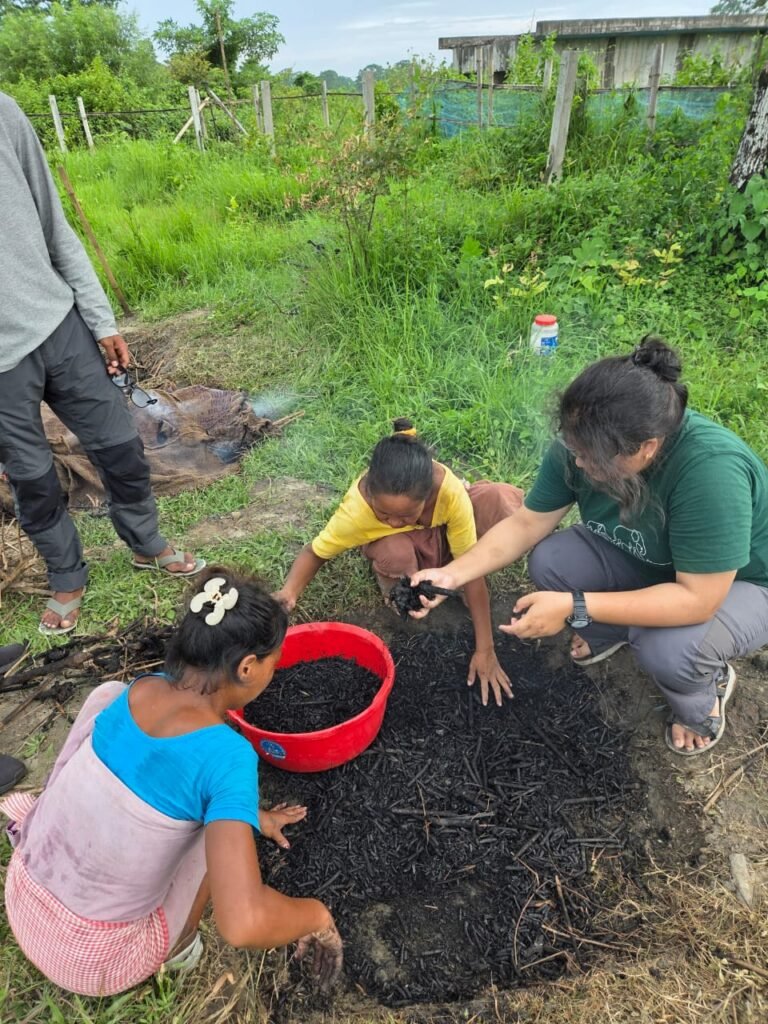
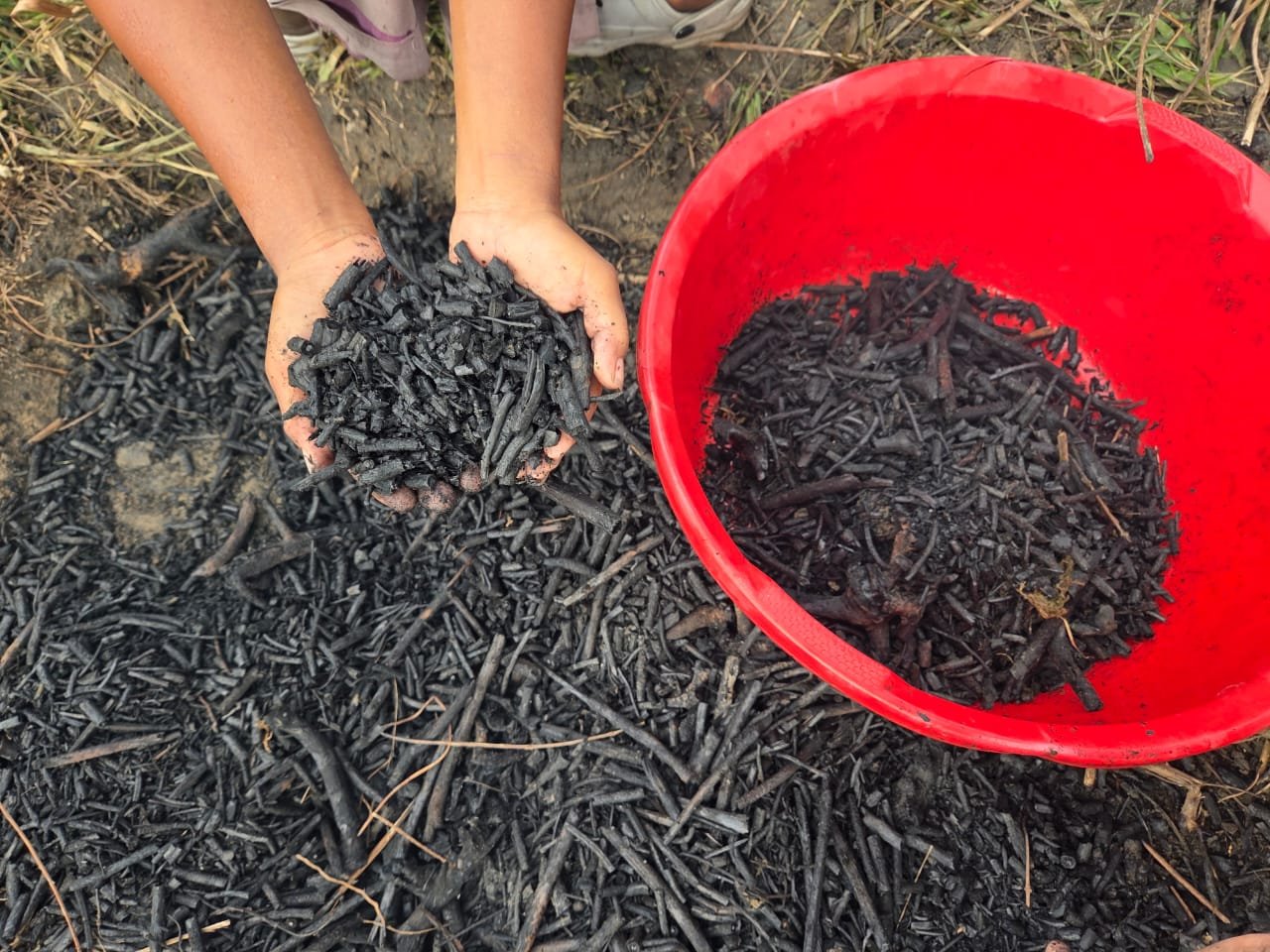
An important component of the intervention is what happens to the biomass after IAP removal. Rather than treating the removed vegetation solely as waste, it has been converted into biochar through controlled thermal decomposition under limited oxygen conditions.
This transforms the biomass into a relatively stable, carbon-rich material and provides an opportunity to retain a portion of the carbon originally fixed through plant growth in a more persistent form when incorporated into soil.
Biochar properties vary considerably with feedstock and production conditions. Its porous structure can influence soil water retention, nutrient retention, aggregation and microbial habitat, although the magnitude and direction of these effects depend on soil characteristics, biochar quality and application rate.
The biochar generated through this intervention can therefore be assessed for appropriate use in restoration plots and local agricultural systems, including as a component of soil or compost-based amendments.
This forms a closed-loop IAP biomass management approach: biomass is removed to reduce excessive IAP dominance, converted into biochar, and returned to the soil within the same landscape as a potentially useful soil amendment.
The current work represents an initial phase of ecological recovery, combining targeted IAP management, natural and seed-ball assisted regeneration, and biomass utilisation.
The treated area will be monitored periodically for IAP re-emergence and regeneration, with subsequent removal undertaken where necessary to prevent renewed dominance and sustain the space created for native vegetation recovery.
Biochar is a simple, charcoal-like material that can help improve agriculture while creating new livelihood opportunities for rural communities. It is produced by heating agricultural waste, such as crop residues and other plant materials, under controlled conditions with little or no oxygen. Instead of burning completely into ash, the organic material is converted into a stable form of carbon known as biochar. One of the important advantages of biochar is that it remains in the soil for a long period because it decomposes very slowly. Its porous structure works like a sponge, helping the soil retain water and important nutrients. These tiny spaces also provide a suitable environment for beneficial microorganisms, which can contribute to healthier soil and better plant growth.
In areas of Udalguri where the soil is often dry and water availability is limited, biochar can be particularly useful. During periods of low rainfall, farmers may leave their agricultural land uncultivated because the soil cannot retain enough moisture to support crops. At the same time, these unused agricultural fields may become areas where wild elephants enter in search of food. Biochar can contribute to addressing both challenges.
Agricultural and invasive plant materials removed from the land can be converted into biochar, while suitable native plant species can be introduced and grown in the area. Over time, these native plants can improve soil conditions, provide additional vegetation and food resources, and contribute to a healthier local ecosystem.
Biochar also has the potential to support farmers’ livelihoods. Since it can be produced from agricultural waste and other organic materials that are often discarded or openly burned, the production cost can be relatively low. With simple training and locally available materials, community members can learn to produce biochar within their own villages.
Farmers can use biochar together with compost or organic manure in their fields to improve soil fertility and moisture retention. This can support healthier and more resilient crops and may reduce the need for large amounts of chemical fertilisers. Any surplus biochar can also be sold, providing farmers with an additional source of income and creating a small-scale village-based livelihood opportunity.