
Article by Ashoke Kr. Das, PhD, Asst. Professor, Botany, Abhayapuri College & Coordinator, Aaranyak West Zone
There is a stretch of National Highway No. 117 in western Assam where the rumble of speeding vehicles once drowned out the calls of a disappearing primate. Today, if you drive slowly between Kakoijana and Tulungia in Bongaigaon district, and if you are lucky, you may look up and see something extraordinary: a troop of golden langurs crossing the road without ever touching the asphalt. They move along a slender bridge of insulated wire, suspended between two electric poles, as calmly as if they had invented it themselves. This is the story of how a dead langur, a grieving village, a few local conservationists, and a few government officials who listened wrote a new chapter in Indian conservation.
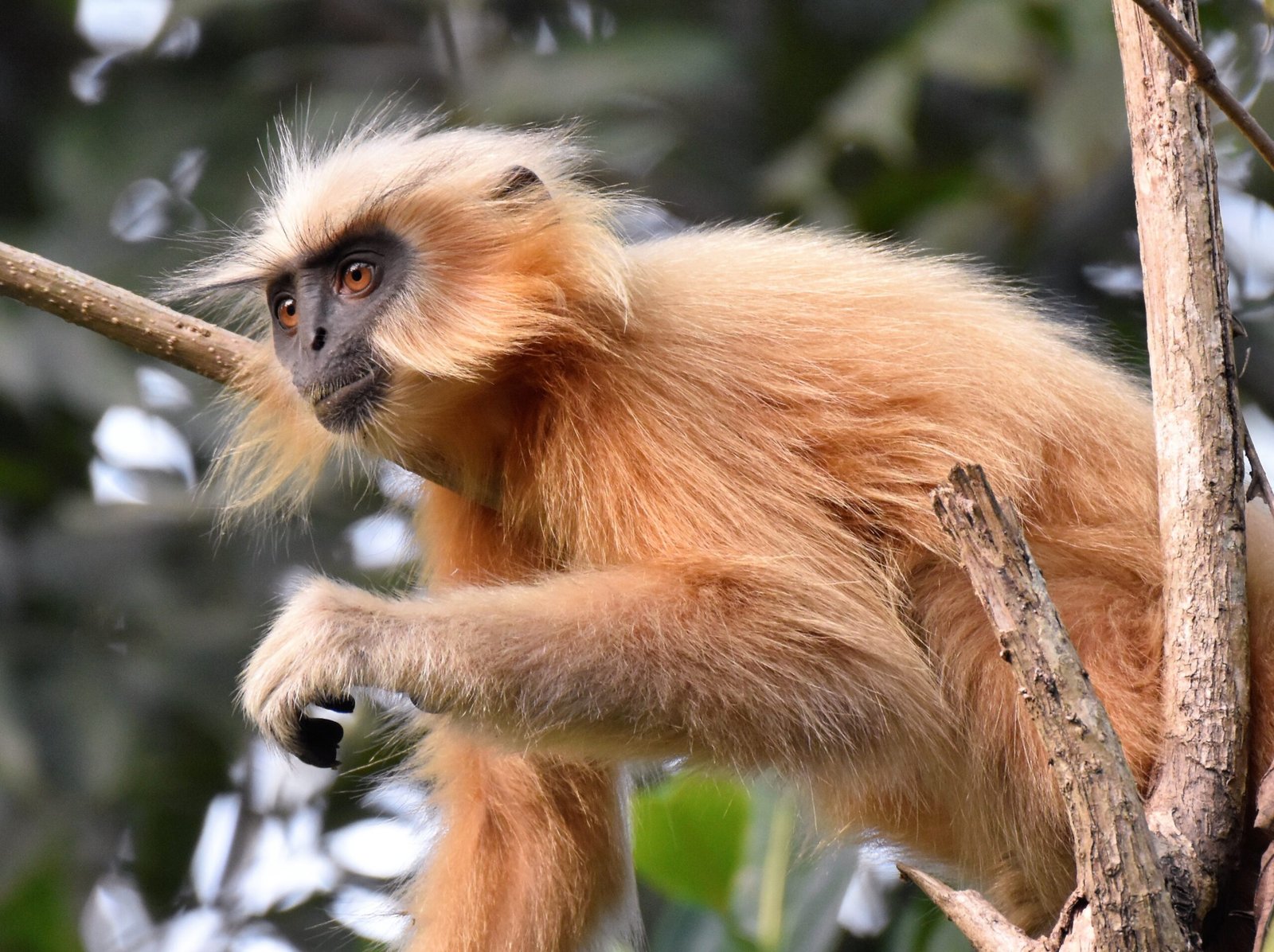
The golden langur (Trachopithecus geei), popularly known as Sonali Bandor is a creature of rare beauty, found nowhere else on earth except the forests of western Assam and Bhutan. Its golden coat, black face, and long white-tipped tail make it unmistakable. For centuries, it lived in the dense canopies of Kakoijana Reserved Forest, an eighteen-square-kilometer patch of green surrounded by fifteen villages in Bongaigaon district. The Aie River flows to the east, and National Highway No. 117 runs between the forest and the river, slicing through a landscape that once belonged entirely to the langurs.
But the forest has suffered. Historical logging, encroachment, and the political turbulence of the 1980s stripped away much of the canopy. With fewer food plants inside the reserve, the langurs began doing something they had never done before. They stepped out of the jungle and into the home gardens of nearby villages—Tulungia, Kakoijana, Sidalsati, Sesapani, Garugaon, Hapachara, Kuchiakata, and Sarakola. To move between patches of food, they had to cross the national highway.
For a while, they managed safely, using specific corridors where large trees on both sides of the road touched each other overhead, forming natural bridges. But when the old National Highway 31 was widened into four-lane NH 117, those trees were felled. The langurs kept crossing at the same spots, out of habit and necessity. Now, however, there was no canopy above them—only speeding traffic.
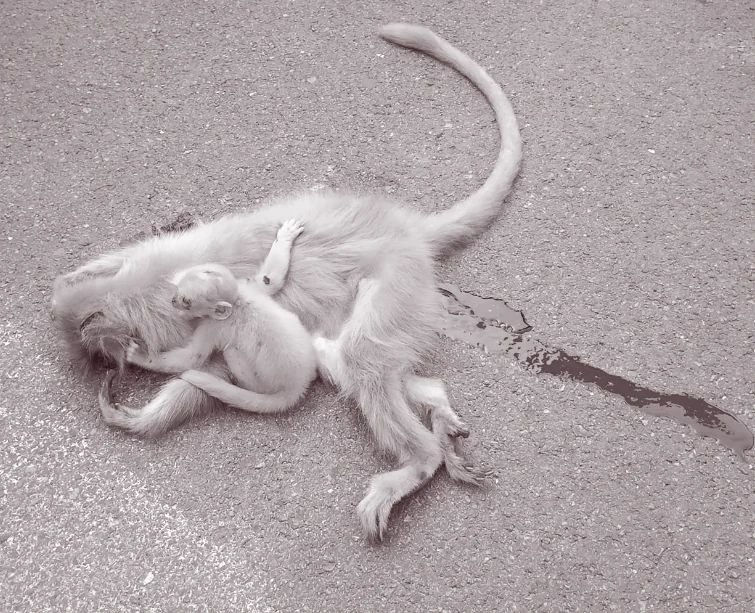
The accidents began to mount. According to available records, from April 2020 to January 2025, ten golden langurs died under the wheels of vehicles on this single stretch of road. Nine were adults; five of them were potential mothers. One was an infant. Each death was a small extinction in itself.
Then came the morning of 4th January 2025.
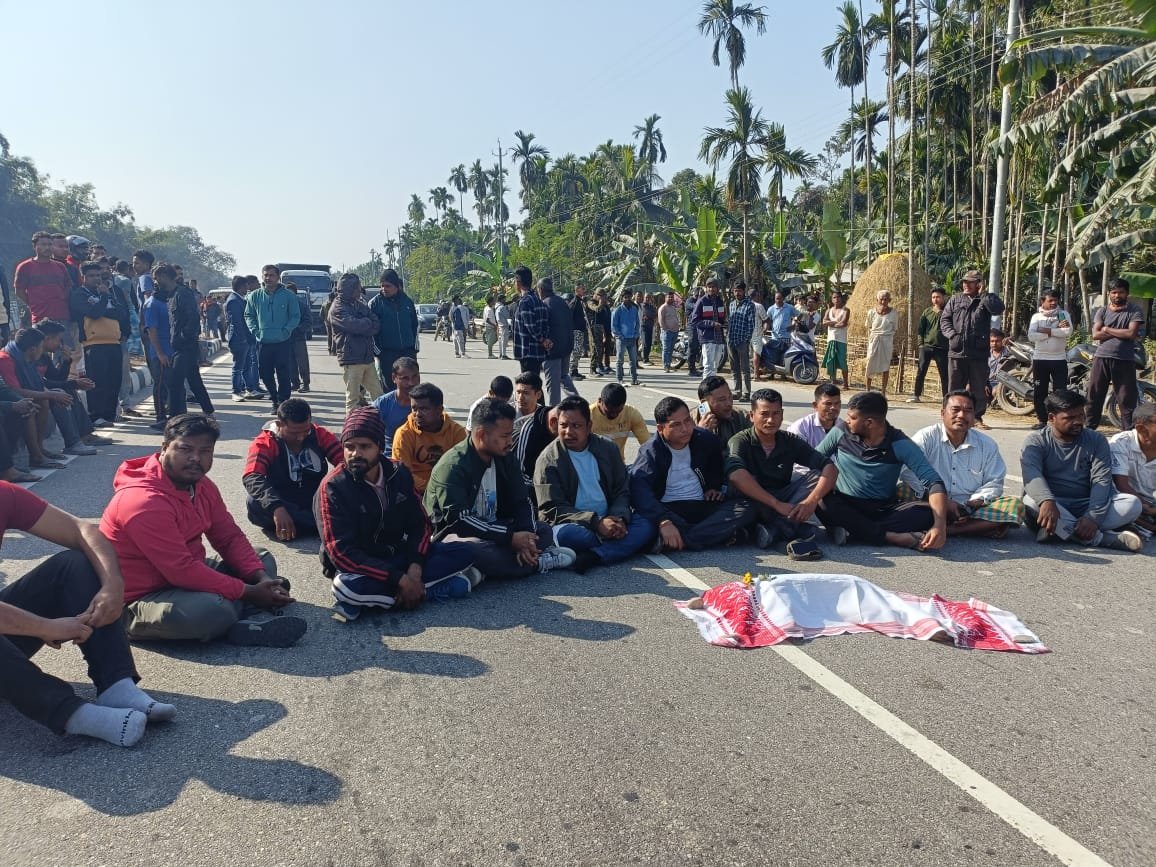
A female golden langur was struck by a speeding vehicle. By 8:30 AM, the news had spread. Local conservationists, NGO volunteers, young men and women from the village, media persons, and ordinary shopkeepers gathered at the spot. They did not come with stones or slogans of anger. They came with grief. They stood around the langur’s body and blocked the highway. For two hours, traffic came to a halt. And there, on the asphalt, the villagers held a public mourning for a monkey.
It was an unusual sight, even for Assam, where people share a deep bond with nature. But what happened next was even more unusual. The administration did not send police to clear the road. Instead, the District Commissioner arrived, along with the Superintendent of Police. Officers from the National Highways & Infrastructure Development Corporation Limited (NHIDCL) came. The Divisional Forest Officer was there, as was the District Transport Officer. They did not stand at a distance. They stood with the public, looking at the dead langur.
By noon, a public meeting was underway in a nearby classroom at Kakoijana Soulmari LP School. No microphones, no podiums—just people sitting on school benches, deciding what to do. The decisions that emerged that day were remarkably clear and practical. The administration agreed to install five artificial canopy bridges at the very corridors where langurs had always crossed. Forest guards would patrol the highway during daytime. Speed breakers and water drums would slow down vehicles. Signboards would warn drivers. And the forest department would plant langur food plants inside the reserve, so the animals would have less reason to leave.
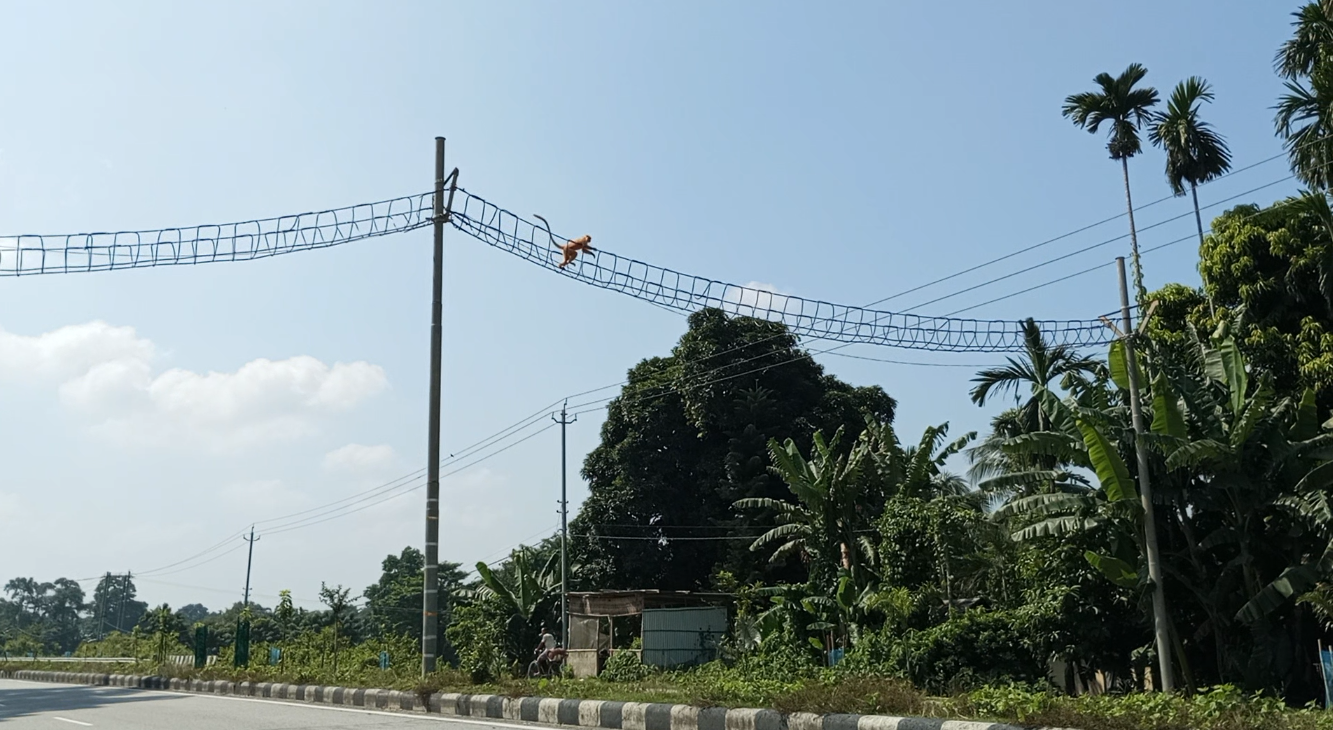
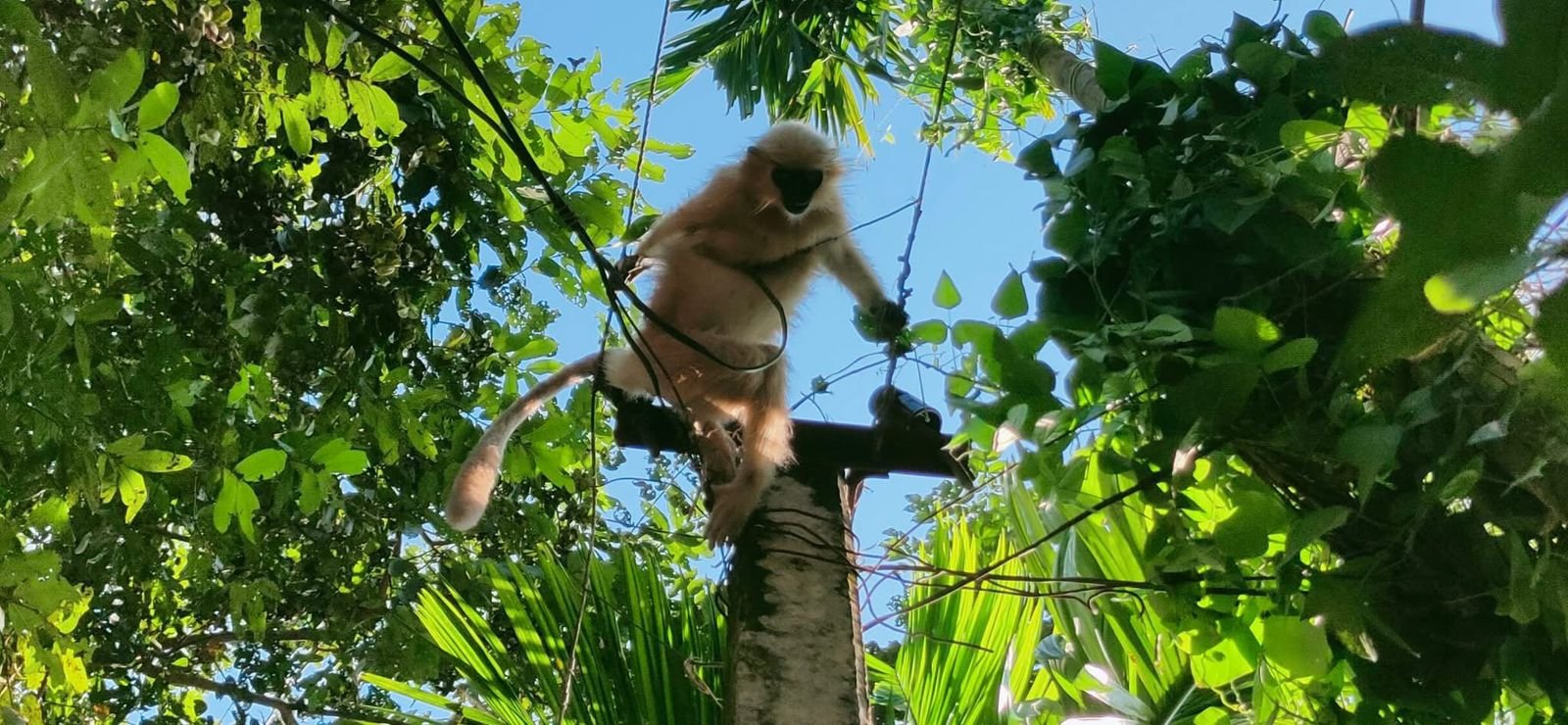
Five days later, on 9th January 2025, the first canopy bridge went up. It was a simple thing: a ladder-like bridge made of insulated electric wire, strung tightly between two long electric poles on either side of the highway, then attached to nearby branches of big trees. No grand engineering, no expensive materials. Just a ladder bridge in the sky.
Nobody knew if the langurs would use it. They are cautious animals, suspicious of anything new. For five days, the wire hung empty while vehicles roared below.
Then, on 14th January 2025, the villagers saw something that made them catch their breath. A troop of golden langurs approached the highway. They stopped at the edge. They looked at the bridge. One of them—likely the alpha female—stepped onto it. The bridge swayed slightly. She paused, then took another step. Behind her, the rest of the troop followed. One by one, they crossed the highway without ever coming close to the traffic below. This is believed to be the first recorded instance of golden langurs using a man-made canopy bridge anywhere in the world.
Today, all five bridges are in place. The langurs use them regularly whenever they need to move between the forest and the village gardens. Daytime patrolling continues. Speed breakers slow the traffic. And since that mournful morning of 4th January 2025, not a single golden langur has died on this stretch of highway.
It is important to name those who were actively engaged in the process. Government officials included: Sri Nabadeep Pathak (then DC, Bongaigaon), Mohan Lal Meena (then SP, Bongaigaon), Kahanindra Kalita (DFO, Aie Valley), local police officers, officers from the National Highways & Infrastructure Development Corporation Limited (NHIDCL), officials from Abhayapuri Forest Range, and officials of the Bongaigaon District Transport Office.
The villagers of Kakoijana, local conservationists, and media persons included: Harmohana Rabha (Aaranyak Member), Sanjib Ray, Bikram Ranjan Roy, Dharam Ranjan Roy (Aaranyak Member), Ankur Barman (Aaranyak Member), Kankan Bayan, Jyotisankar Choudhury, Late Hitesh Ray, and Ankur Jyoti Ray. These individuals labored without expecting or receiving a single rupee. They climbed poles, strung wires, and secured the bridges purely out of love for the golden langur and their land.
But roadkill was not the only killer.
Between 2012 and December 2024, fourteen golden langurs died by electrocution in the villages around Kakoijana. Thirteen of them were females. Open electric wires, strung haphazardly through the trees, had turned the village canopy into a death trap. Once again, local people raised their voices. Once again, the Bongaigaon district administration listened. The Assam Power Distribution Company Limited (APDCL) replaced almost all open wires with insulated ones. Transformers were given protective barriers. Today, electrocution deaths have almost stopped in these villages.
If the story ended here, it would be a perfect one. But conservation is never finished.
The golden langur population is growing. That is good news, but it brings a new challenge. The langurs are now moving into other nearby villages—places where canopy bridges have not been built and wires remain open. In December 2024 (prior to the bridge installation), an adult male langur was electrocuted in Sankarghola village, near the Bhairab Hill Reserved Forest. Similar close calls have been reported from the fringes of Malegarh Reserved Forest.
The lesson from Kakoijana is clear and urgent. When communities care and administrations respond, solutions can be simple, cheap, and immediate. A wire bridge costs little. Insulated wiring costs little. Speed breakers cost little. But their absence costs the life of a species that exists nowhere else on earth.
The golden langur has survived logging, encroachment, political instability, speeding cars, and naked wires. It has survived because the people of Tulungia, Kakoijana, Sidalsati, Sesapani, Garugaon, Hapachara, Kuchiakata, and Sarakola refused to look away. They blocked a highway not with anger, but with grief. And that grief built five bridges. The good news is that more bridges are planned in the near future.
Now, the question is whether the same grief—and the same determination—will reach Malegarh, Bhairab Hill, Bamungaon, and every other fragment of forest where the golden langur still clings to existence.
The wire is ready. The poles are standing. All that is needed is for the rest of us to care as much as a small group of people did on a January morning in 2025, standing on a highway, mourning a langur.
Acknowledgements: The author acknowledges the contributions of local conservationists, the Forest Department, NHIDCL, APDCL, and the District Administration of Bongaigaon.
Dedication: This article is dedicated to the memory of the ten langurs who died on NH 117 before the bridges were built.
Declaration regarding data collection:
The author declares that all data presented in this article—including mortality records, langur behavior observations, and community testimonies—were collected personally through primary field research. No third-party data sources were used without verification.