

By Anushka Saikia
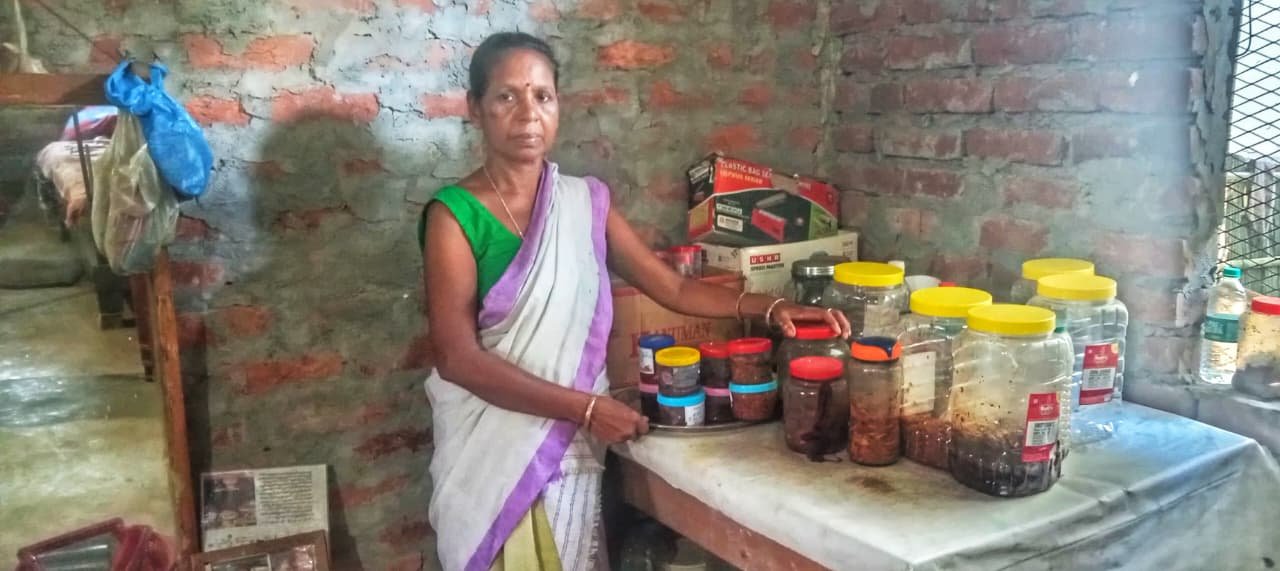
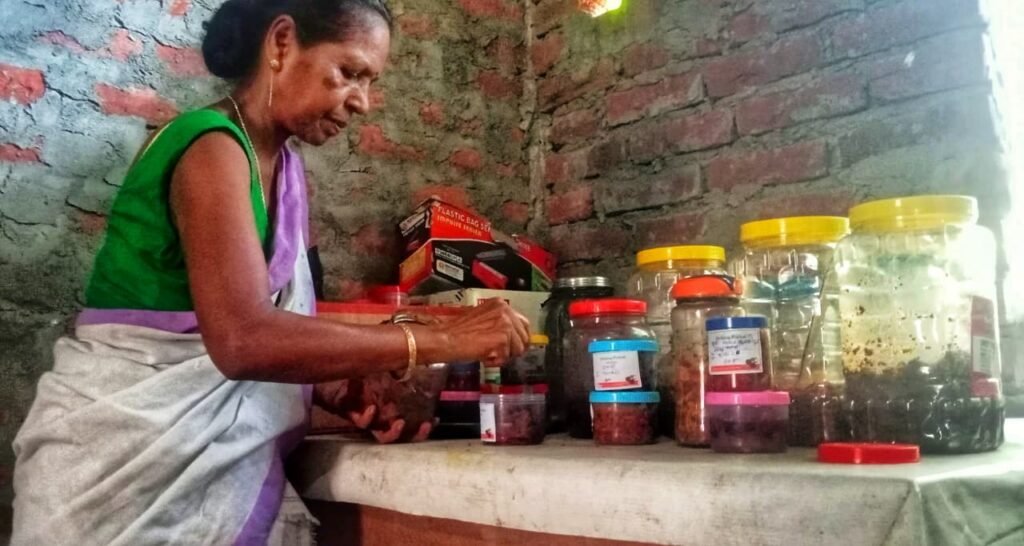
Every Sunday morning, before the bustle of the Jeypore weekly market begins, 49-year-old Madhuri Das carefully arranges glass jars filled with mango, bamboo shoot, elephant apple, and king chilli (Bhut Jolokia) pickles on a small wooden table. Each jar carries a simple label- Dehing Patkai Pickles.
People now know her by that name. But not long ago, very few people knew Madhuri at all.
For years, life in Tanti Pather village, on the fringes of the emerald forests of Dehing Patkai National Park in eastern Assam, was defined by uncertainty. In this village on the edge of one of India’s richest rainforests, elephants wandered through paddy fields as naturally as rivers found their course. A single night could erase months of labour. A family could sow an entire season’s crop only to wake up to trampled fields and empty granaries.
It felt like salt rubbed into an open wound when Dehing Patkai was declared a National Park in 2021. The forest that had quietly sustained generations suddenly became a landscape governed by stricter protection. Activities that had long supplemented fragile rural incomes – grazing cattle, collecting firewood, or harvesting forest resources – were no longer legal options. Families felt as though two doors had closed at once. One was the land, increasingly vulnerable to elephants. The other was the forest, now protected by law. For women like Madhuri, survival could no longer depend on either.
A single woman living alone, Madhuri survived through daily wage labour whenever work was available. On better days, she prepared small batches of pickles and sold them to neighbours. The income was irregular and barely enough to sustain her. She knew how to make good pickles. What she lacked were equipment, packaging, branding, reliable markets, and the confidence that someone would actually buy what she made.
When Aaranyak, together with the British Asian Trust and Elephant Family under the Darwin Initiative, began identifying households most vulnerable to the knotted pressures of conservation restrictions and human-elephant conflict, Madhuri’s story stood out. She did not ask for charity; she simply asked for an opportunity to build on something she already knew. The support she received was humble : a mixer grinder, a packet-sealing machine, jars, packaging materials, labels, and the raw ingredients needed to begin production.
More importantly, there was guidance on presenting her products professionally, maintaining simple financial records, and connecting with local markets. Gradually, her pickles found a name, Dehing Patkai Pickles. The branding gave customers something to remember. Better packaging meant local shops were willing to stock her products. Weekly markets expanded her customer base. Through community market-linkage initiatives like Xupan, her products reached buyers beyond her village. Soon, instead of waiting for customers, she began receiving orders. Between January and June 2026 alone, Madhuri sold berry (Indian jujube), garlic, mixed vegetable, elephant apple, chilli, mango, garcinia, ghost chilli, and bamboo shoot pickles worth more than ₹20,000. After accounting for expenses on ingredients, spices, and packaging, the earnings represented something far greater than profit. For the first time, her livelihood depended less on the uncertainties of forests and fields and more on her own enterprise. Yet, the significance of her story does not lie in the amount she earned. It lies in what her income represents.
When households depend entirely on crops that elephants can destroy overnight, every raid deepens frustration. When livelihoods depend on entering protected forests, conservation laws become difficult to accept. But when income begins to flow from activities that elephants cannot trample and forests need not provide, the relationship between people and wildlife quietly begins to change, and the economics of conflict slowly starts to shift.
A pickle business cannot stop elephants from walking through a village. But it can do something equally important. If a modest yet dependable source of income exists, the tolerance that these communities have towards their giant neighbours is less likely to erode over time. The assurance that an elephant raid will not wipe out a family’s only source of income makes a difference that truly matters.
Today, Madhuri buys fruits and vegetables from nearby villages, commissions local people to collect seasonal produce such as elephant apple, garcinia, and bamboo shoots, and adds value before selling them under her own brand. In doing so, she has created a small local supply chain where others also earn alongside her.
Imagine this story repeated not once, but across hundreds of households living in human-elephant conflict-prone landscapes across Assam. Imagine every village identifying its own strengths – pickle makers, weavers, mushroom growers, potters, lemon cultivators – and receiving the modest support needed to transform these skills into sustainable enterprises. The cumulative impact would reach far beyond household incomes. It would reduce dependence on forests, soften the economic shocks of human-elephant conflict, strengthen local markets, and perhaps most importantly, replace resentment with resilience.
Conservation is often imagined as something that happens inside protected forests through laws, fences, trenches, or patrols. But it can also be reimagined through livelihoods that give people a reason to choose conservation because it safeguards their own future as well.
Madhuri’s journey is just one dot on the vast canvas of a broader philosophy of conservation that reimagines conservation as a model that is practical, sustainable, and economically empowering for marginalized communities.